Where Have All the Gurus Gone?
2008
A long time ago, back in the day, we set out to find the answers to the big questions - the really big ones about life, and meaning, and the nature of consciousness. There were millions who shared that search for meaning in the wake formalized religions, dismissed by many of us as obsolete and increasingly out of step with the realities of modern life. We read everything and experimented with mind-altering substances.
We were surrounded, in those days, with a seemingly limitless number of self-proclaimed 'enlightened beings' whose followers often believed them to be the living Messiah - the Buddha. Today, many people (mostly aging hipsters like me) still follow gurus, but the actual cults of personality that once surrounded these figures seem to be vanishing as quickly as the polar ice caps and as mysteriously as the honey bees. There are still enlightened beings available to guide seekers along their own paths to enlightenment, but the very concept of enlightenment, once a hot topic of discussion, seems to have vanished into irrelevancy.
Our generation, and those of our parents and grandparents, came into adulthood believing in the power of ‘great men’. The 19th Century, Scottish historian Thomas Carlyle even posited - the 'great-man theory of history'. He maintained that all significant shifts and advances in history came about as the result of individual vision and genius that was imposed upon the word through a variety of means - both coercive and inspirational. The great ‘culture-heroes’ of the world have changed as humanity has evolved and, but the religious heroes - Jesus, Buddha, Lao Tzu, Krishna, Mahavira, Mohammed and Moses were never replaced or updated. No major world religions were initiated after Islam in the 7th Century CE, but there were plenty of smaller ‘cults’ of enlightened teachers, prophets and holy men. The belief in the redemptive power of the Messiah became (and still remains to a large degree) the central idea in virtually all Western religion and to some extent are a part of all religions.
The centrality of the Messiah in Western Culture was an essential principle long before the advent of Christianity. The Man-Gods of Ancient Greece, Egypt and Mesopotamia were based on the belief that the Gods occasionally came to earth in human form and were able to create magical transformations through which mankind benefitted. Socrates and Plato believed that humans were incapable of great art without the direct assistance of the Gods – the power of art lay solely in their hands and was shared with mortals only through their Divine acts of grace and benevolence. The great artists of ancient Greece were seen as the conduits through which the gods worked their magic - not as individual geniuses. By the time of the Roman Empire the emphasis shifted to the artists themselves as well as the figures they depicted – both mythic and historical. In the ‘Dark Ages’, artist once again became mostly anonymous and largely indistinguishable from their artwork. The emphasis in European art and Islamic art was on the religious figures wh9ch were invariably depicted in stylized manners accessible to the general masses as well as clergy. In the Renaissance the idea of direct genius in art – the ‘great master’ era reached new peaks of adulation and acclaim. The imperial monarchs of European history were based on the cultural concept of a heroic leader – divine right protector who would bestow safety and security because of their mystical representation of the one true God. In Judaism, there is the promise of the Messiah as yet unfulfilled. For Christians, the central dogma and faith in the divinity of Jesus Christ transcends all denominations. For Muslims, the eternal pattern of the universe replaces the anthropomorphic divinity of Christianity.
As a person of the 20th Century, I tend to believe in good and evil, truth and beauty, social justice and even the possibility of Divine grace of some sort or other. I don't believe in the Divine right of kings. I have no guru, though I have had many spiritual teachers - some of whom thought of themselves that way, and others who did not. I have paid close attention to the lessons of a new generation for whom beauty and truth and spirituality are not so easily defined. Some day, this may be remembered as the post-messianicgeneration.
The world now defines itself in relativistic terms - 'post-modern', 'neo feminist', 'late-capitalist', 'multi-cultural', and even 'post-racial'. Francis Fukuyama, in Harper's Magazine, February 1982, went so far as to describe the current period as the era of post-history! With these new canons of relativity have come cynicism, self-righteousness and the essentially un-interrupted manipulation of power by the cultural elite. We congratulate ourselves for living in a world-culture - a community of different perspectives and histories that now share an increasingly similar vision of cultural identity. Non-Europeans are now welcomed into the international ‘inclusive culture’ as long as they acknowledge the tropes established by the European and American elite – democracy, social equity, material well-being for all and human rights. The world is losing the old vestiges of individual cultures and merging into a single ‘world’ culture that drives Toyotas, eats pizza, speaks English, and seems material well-being as the ultimate goal of life. This world culture lives all over the planet and is connected through a relatively new invention - the Internet. ‘Spirituality’ is increasingly not a part of mainstream discussion about culture, meaning and identity.
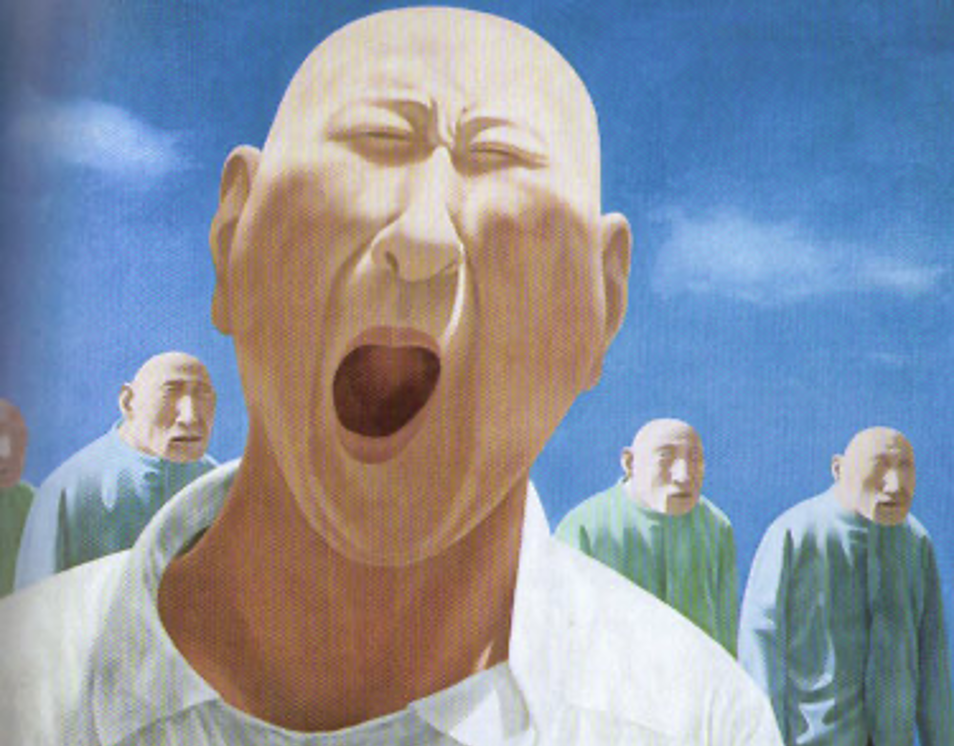
Series 2, Number 2, Howl Fang Lijun 1992
The art world reflects the realities of our times and gives us special insights into what the world has been and what it is becoming, in a ‘spiritual’ sense. Meaning itself is re-defined in terms of identity and oppression. Today the art world demands spectacle and frivolity for which eager patrons compete in the most conspicuous venues for the display of wealth and power – hallmarks of a world culture they believe themselves to have manufactured, but which is as elusive as the issues of ‘quality’ and ‘innovation’ that once were synonymous with ‘value’ in art and culture. The Chinese 'Cynical Realist' artist, Fang Lijun was the first of many Chinese contemporary artists to sell his artwork for more than a million dollars. His work is highly valued in Europe and America, but less so in China. The West still views so-called 'world-culture' as a party at which they are the hosts. In the rising cultural traditions of East Asia, however, people see things differently. The world community seems inevitably poised towards de-Europeanization, but that doesn't necessarily mean another super-power will emerge to gain cultural hegemony. Something fundamentally different has already begun.
There is an important change in the world. It's so big and so profound we've barely noticed it, but its effects may change the world as significantly as the invention of fire, the domestication of animals, or the origin of the written word. The change is holistic and global - like the events that led to the extinction of dinosaurs. It is intertwined with the globalization of the economy, technology, and the nascent new world culture itself. It coincides with the trend that suggests that by mid-21st century that China may have become the dominant political, economic and cultural power on the planet.
Technology and geography are part of the change - but they are not the change itself. These changes in which we are now we're amidst, are so strange and unexpected that many of the generation of baby-boomers - now all moving beyond our 60th year - seem as incapable of grasping them as our grandparents were unable to grasp mass media, telecommunications or the fading out of organized religion. These changes are inexorable from the new sensibility among the world’s youth founded on the effects of digital networking and social media but, like the invention of fire, move beyond a single invention and into profound changes in the nature of the entire species. It is changing forever our notions of spiritual enlightenment and cultural identity. Our world is ‘relational’ in ways that the West must struggle to conceptualize. East Asia, in comparison, seems better prepared to understand and prosper in a world in which there are no more absolutes.
We're all aware that for the first time in human history there is instantaneous access to virtually all information known to human-kind and instant human response to new ideas and concepts. Facebook now approaches a billion members - friends in a complex network of interaction and connection. Everyone under the age of 40, it seems, is in more or less constant connection with friends, data-bases, opinions and ideas. We seem to have very suddenly shifted all of the basic assumptions about who we are, what we value, and what we should do in the world. It is a change far more important than the technology or social relationships that support it. The changes we are now beginning to experience will continue for centuries. The changes are so pervasive that they can, paradoxically, barely be noticed.
The Western world maintains a view of spirituality based on distinctly Eurocentric principles.
We discuss spirituality in terms of personal enlightenment, or the revelationof truth – implying that we (individuals) receiveenlightenment from another individual. In Europe and America our spiritual thinking is conditioned by the traditions of Judaism and Christianity one of whose primary sources of spiritual agreement is the belief in the redemptive inevitability of the Messiah. The primary point of disagreement is simply whether or not Jesus was that Messiah, who would bestow grace and forgiveness for our sins and endow us with eternal life.
Several years ago, an art therapist friend of mine in Singapore, was doing her Master’s degree there. She had been conducting individual research into the use of collaborative techniques between psychotherapist and patient that led to the out-of-hand rejection of her thesis by the newly appointed Chair of her department – a white, American woman from Queens, New York.
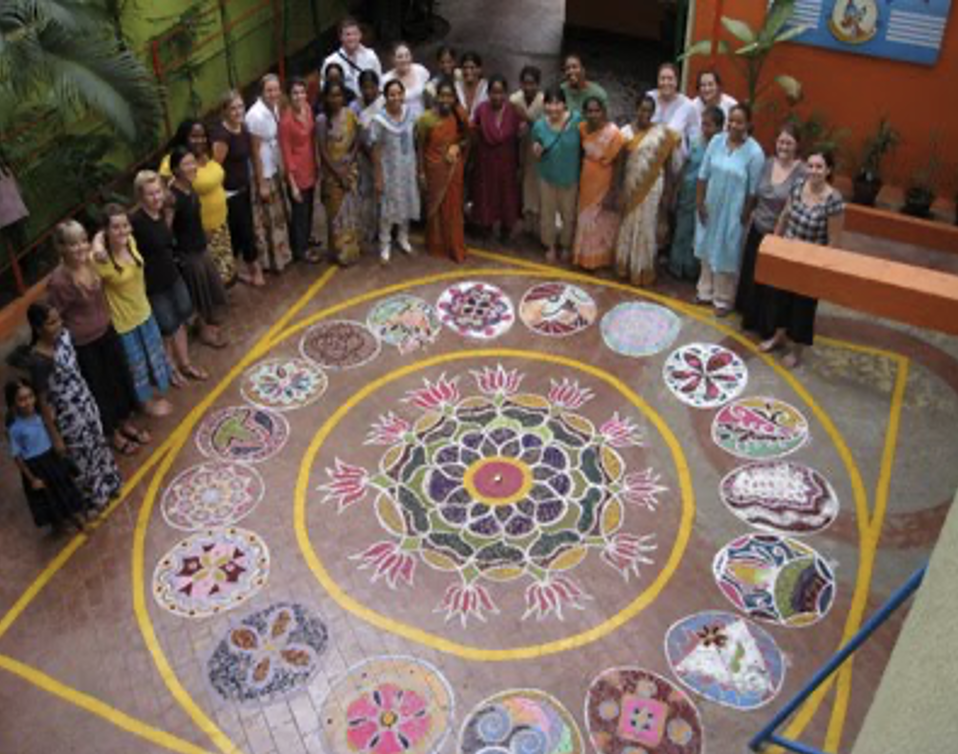
Collaborative Art Therapy Project in India - GW University
She was adamant that my friend’s technique violated the most basic principles of psychotherapy – the separateness of therapist and patient and the development of transference that were once
assumed universally to be one of the most important and inviolable principles of psychoanalysis. My friend was told, off-handedly by this new department chair, that she would have to abandon her research and choose another direction if she expected to obtain her MA degree from that program. The young art therapy graduate student heroically refused to accept this judgment and initiated an internet dialogue among art therapists from around the world about why collaboration was seen as contrary to the rules of psychotherapy and whether community and inter-connectivity were not equally essential to psychotherapeutic process. Her basic premise was brilliant – psychoanalysis as envisioned by Freud and his early colleagues, was based on the principles of Judaism and Christianity – the expectation of salvation by a surrogate Messiah (the therapist). She made the point that in Singapore, they weren’t mostly Jews or Christians -- they were mostly Buddhists, Muslims and Hindus. Their tradition was not based on the Messiah – it was based on non-duality and interconnection! After several months of dialogue, the Chair left her position and my friend received her MA degree. She received enthusiastic support from those distinguished art therapists, educators, artists and psychotherapists from around the world and in so doing altered the entire conversation about the cultural biases of psychotherapy. My friend’s ideas of collaborative art therapy have been repeated in art therapy programs and practices around the world. She now practices ‘Buddhist-based Art Therapy’ in Singapore. The real heart of her work is the idea of inter-connection. She acknowledges fully that the healing in art doesn’t come from the therapist – it comes from the act of connection that occurs when one expresses the 'self' and the ‘other’ receives that expression as beauty or truth. It’s a shift from the power of the heroic savior to the innate power of inter-connection itself.
If one sees the contemporary world as a new kind of cultural fusion, distinct from the hegemony practiced for the last couple of millennia, by the cultural decedents of ancient Greece and Rome, then we must also understand that other cultural concepts are emerging. Our ideas of spirituality seem no longer to be based on the Messiah, or the singular living God. We have emerged from the era of world-wide Eurocentrism in many regards and in so doing are embracing an entirely new model of universal spirituality.
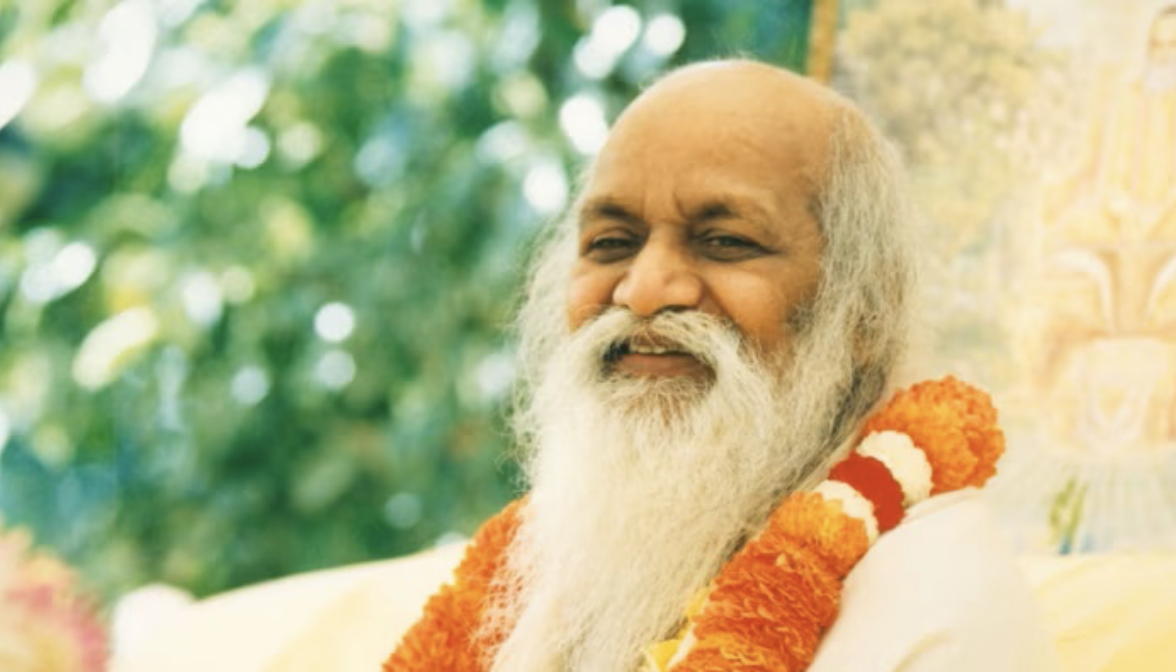
Maharishi Mahesh Yogi
The abandonment of the Messiah concept is a very recent change – and a complicated one that still hasn’t emerged for real discussion. Certainly there are hundreds of millions of devout Christians and Jews who would reject this idea. Many others in Europe and America, in the latter part of the 20thcentury, however, challenged the old religious ideas – formalized religions declined worldwide and in some quarters were replaced by cults of personality – the new Messiahs. Ours may have been the last generation to seek out and devote ourselves to great spiritual teachers.
In India devotion to a spiritual teacher is still a wide-spread practice, but there too, it is rapidly being replaced by a new vision of spiritual learning. Our generation started to lose interest in the old-time religions we inherited from our parents and grandparents. In our search for new meaning and spiritual truth, we did as we had been programmed to do – we set out to find a new savior who would intervene in our lives and carry us to individual enlightenment.
The rise of the Maharishi Mahesh, Chögyam Trungpa, Sun Young Moon, Elijah Muhammed, Swami Satchadananda, L. Ron Hubbard, Rajneesh (Osho), and hundreds of other famous, and often profound, spiritual teachers once created a thriving international
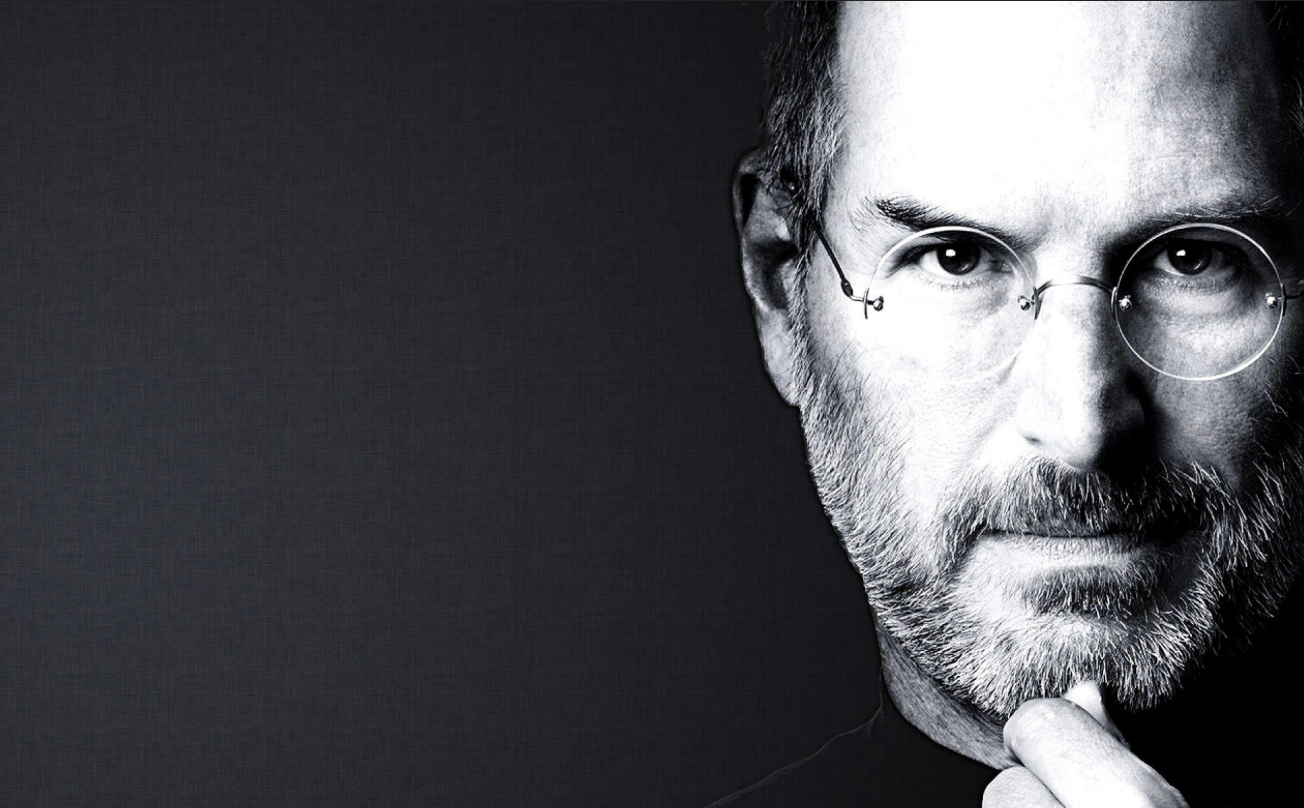
Steve Jobs
marketplace for the idea of personal enlightenment. They provided a Messiah figure for anyone who was inspired to follow them, but after thirty years or so, things changed. Many of the organizations based on the enlightened teachings of great gurus suddenly seem to have declined or even disappeared. The popularity of the ‘enlightened’ teachers has largely eroded – despite an on-going desire among the new generation for a sense of meaning and purpose in the world. As the mystical Messiahs of the 20th Century faded from popularity and public view, new less mystically inclined culture-heroes and role models emerged. Steve Jobs, founder of Apple Computers, may have been the prototype of a new kind of guru – far greater than just a purveyor of new technology, or billionaire entrepreneur – Jobs may have been instrumental in creating a new planetary consciousness, without ever knowing that he was doing it. Steve Jobs, whose trade-mark expression, ‘insanely smart’ seems to have become the new term for enlightenment and connection.
The new generation – the so called “Millennials” – was heralded at their birth as a miraculous new spiritual awakening of humanity. Remember the ‘Indigo Children’ of the 90’s? According to psychic researchers Nancy Anne Tappe, Lee Carrol and Jan Tober, they were to be a generation of enlightened beings who would lead humanity into a higher state of consciousness. The prediction gained popularity for a while, but then seemed to fizzle out in a cloud of cynicism for the ‘new age’ and a general sense of skepticism and doubt about nearly everything. So, who are the Indigo Children today? Is there any credibility to the prediction made by Tappe, Tober and Carrol? Is there a new generation of enlightened beings among us? Maybe.
The Indigo Children are now in full adulthood. They’re sometimes seen as more cynical than we Baby-Boomers were – more sophisticated, less naive, more physically fit and environmentally focused, goal oriented and success driven than were the hippies of the 60’s and 70’s. The Millennials are tech-savvy and constantly connected through digital social media – Facebook, WeChat, Linked-In and Twitter. Instagram, Facebook – currently have 4.5 billion subscribers. If social media were a nation it would surpass India, China and all of the Americas as the largest social network in the history of human kind. The Internet generation may look to the generation of technological giants like Steve Jobs as cultural role models – creative, successful and connective. The grown-up Indigo Children are constantly connected to each other in ways that our generation could simply not have imagined, and now largely do not fully recognize or understand. There is no ‘counter culture’ for the first time since the advent of modernism – no bohemians on the Left Bank, no beatniks, no hippies, punks, goths or hipsters, beyond a few anachronistic sentimentalists who idealize the era of their own parents and grandparents. The Indigo Children are now in their 30’s and 40’s and they havebrought forth a new spiritual consciousness – but it’s not reallywhat we expected.
Michael Grady, 2008 © 2014 all rights reserved
